AI & Research
AI for Sustainability ≠ Sustainable AI
Oct 6, 2026 · 6 min read
In this article
We build AI for people who work in sustainability. That makes one question hard to put down: can we use AI to advance sustainability while ignoring the sustainability of AI itself?
Our answer is no. AI for sustainability and sustainable AI are two different things, and the first does not deliver the second.
The distinction is not ours. It was drawn by a researcher in 2021.[1] AI for sustainability points the technology at goals like the SDGs. The sustainability of AI concerns the footprint and fairness of the technology itself, across its whole lifecycle. The data published since then show how far apart the two can drift.
The benefits are a forecast. The costs are an invoice.
AI’s sustainability benefits and its costs sit on two different ledgers. The benefits are mostly modelled, future and conditional. The costs are measured, present and local.
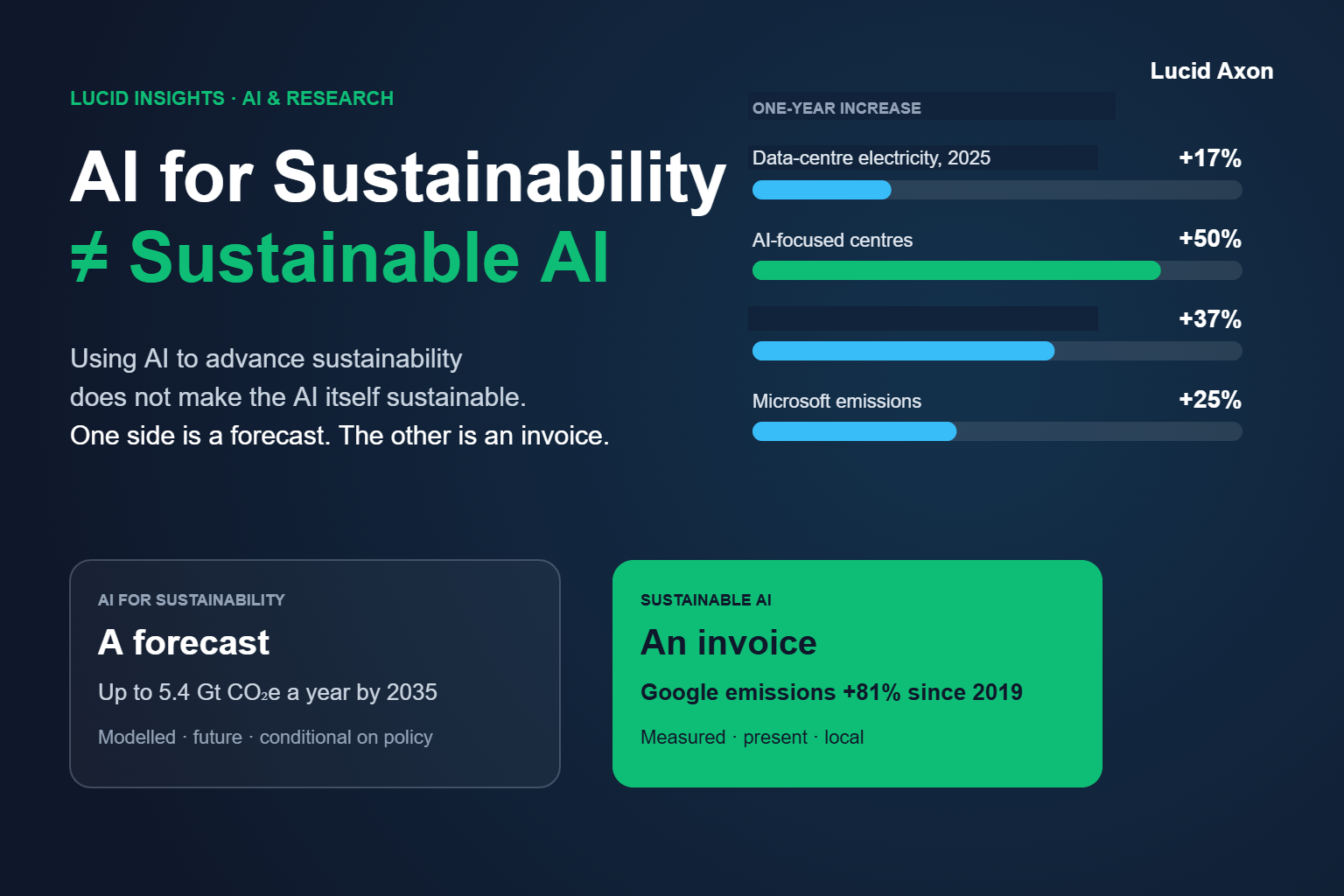
The strongest benefit estimate comes from a Grantham Institute study[2]: AI could cut 3.2 to 5.4 billion tonnes of CO₂e a year by 2035 across power, food and transport. The authors call this a potential that depends on active policy, not an outcome markets will deliver alone.
The cost side needs no scenario.
| What was measured | Figure | Source |
|---|---|---|
| Global data-centre electricity, 2025 | Up 17% in one year; AI-focused centres up 50% | IEA, April 2026 [3] |
| Google total emissions, 2025 | 81% above its 2019 baseline; electricity use up 37% | Google 2026 Environmental Report [4] |
| Microsoft total emissions, FY2025 | Up 25% in one year, to 20.29 MtCO₂e | Microsoft 2026 sustainability report, via DCD [6] |
Both companies have 2030 climate targets, and both attribute the rise to AI infrastructure. Netting a projected global benefit against an actual local cost is the accounting move sustainability professionals reject in the companies they assess. We should not ask them to accept it from us.
Efficiency is real, and it is being outrun
The usual reply is that AI is getting cheaper per query, fast. That is true. Google reports a median[5] Gemini text prompt now uses 0.24 Wh, 33 times less energy than a year earlier.
In the same year, Google’s electricity use rose 37%. The IEA sees the same pattern across the sector: energy per task is falling quickly, and total data-centre demand is still on course to roughly double by 2030.
This is the rebound effect described in recent research.[8] Cheaper intelligence gets used more, and in heavier forms such as agents, reasoning models and video. Efficiency lowers the cost of each task without limiting how many tasks we run.
Per-query numbers also hide a lot. Google’s figure is a self-reported median with market-based carbon. A full lifecycle assessment from Mistral[9] counts training, hardware and upstream water, and lands at 1.14 g CO₂e and 45 mL of water per response. The two cannot be compared until the method is disclosed.
Sustainable also means trustworthy
Energy and carbon are only half of it. Sustainability has always included the social and the governance questions, and AI has its own versions of both.
In sustainable finance the sharpest one is evidence. A language model can summarise a company’s sustainability report fluently and still be wrong, or be right about what the report says and wrong about what the company does. Research presented at a 2025 computational linguistics conference[10] found that even advanced language methods tend to reproduce exaggerated sustainability claims instead of actual performance.
An AI system that repeats greenwashed disclosures as fact scales greenwashing instead of detecting it. An analysis that cannot be traced to its source cannot be audited, and an investment decision built on it cannot be defended.
Regulators have noticed. OSFI’s Guideline E-23 on model risk[11] takes effect on 1 May 2027 and explicitly covers AI models, including those bought from vendors. For Canadian banks and insurers, the AI inside a sustainability tool becomes a model they must govern.
“We are too small to matter”
This is the objection we take most seriously, because it is partly right. A company that builds on other people’s models has a small direct footprint and no say in how those models are trained.
But the choices that remain are the large ones. A 2024 study[7] tested 88 models and found general-purpose generative models far more costly than task-specific ones for the same job. On question answering the gap was roughly 30 times.
Which model, how large, how often it is called, where it runs and whether its output is grounded in evidence are all decided at the application layer. So is what gets disclosed.
Our use of AI also ends up in our clients’ Scope 3 inventories as a purchased service, so their reporting depends on our numbers.
Even clean power is not a free pass. In Quebec, Hydro-Québec expects[12] data-centre demand to grow from about 200 MW to about 1,000 MW by 2035. Hydro-powered computing is low-carbon, and it still competes with electrifying homes, transport and industry.
Five questions every builder should be able to answer
Sustainable AI for sustainability comes down to five questions. We think any team building AI for this field, ours included, should be able to answer them.
- Is AI needed for this task, and which kind? Extraction, classification and tagging rarely need a frontier model. Use the smallest tool that does the job well.
- Can every output be traced to its source? Each claim, score or flag should link to the passage, document and date behind it, and separate what a company reports from what has been verified.
- What does one assessment cost? Energy, carbon and water per unit of work, with the method and its boundaries published alongside the number.
- Why this vendor and this region? Model providers and cloud regions differ in what they disclose and in the carbon intensity of their grids. The choice should be documented.
- Who is accountable when the model is wrong? Human review of material decisions, accuracy audits and a governance standard such as ISO/IEC 42001 or the NIST AI Risk Management Framework.
None of this is exotic. It applies to AI the discipline sustainability professionals already apply to everything else: measure, disclose, and show the evidence.
Holding both ideas at once
We believe AI can help capital find better companies and help institutions make better decisions. We would not be building it otherwise.
That belief is a claim about a handprint, and a handprint only counts when the footprint beside it is known. AI for sustainability is a statement about what a tool is for. Sustainable AI is evidence about how it was built. Our field should expect both. Read how we handle data and models.
- [1]van Wynsberghe, Sustainable AI: AI for sustainability and the sustainability of AI, AI and Ethics, 2021
- [2]Stern et al., Green and intelligent: the role of AI in the climate transition, npj Climate Action, 2025
- [3]IEA, Data centre electricity use surged in 2025, April 2026
- [4]Google, 2026 Environmental Report, 2026
- [5]Google, Measuring the environmental impact of AI inference, 2025
- [6]DCD, Microsoft reports 25 percent increase in CO₂e emissions, 2026
- [7]Luccioni, Jernite and Strubell, Power Hungry Processing, FAccT 2024
- [8]Luccioni, Strubell and Crawford, From Efficiency Gains to Rebound Effects, FAccT 2025
- [9]The Decoder, Mistral AI publishes the first comprehensive life cycle assessment of a large language model, 2025
- [10]Towards Robust ESG Analysis Against Greenwashing Risks, ACL 2025
- [11]OSFI, Guideline E-23: Model Risk Management, effective 1 May 2027
- [12]BNN Bloomberg, Hydro-Quebec to face off against industry actors in data centre hearing, October 2026