AI & Research
AI for Investors Has to Be Sustainable AI
Oct 6, 2026 · 5 min read
In this article
Should the AI that investors use be sustainable? Yes. For investors this is a matter of fiduciary duty and portfolio risk as much as values.
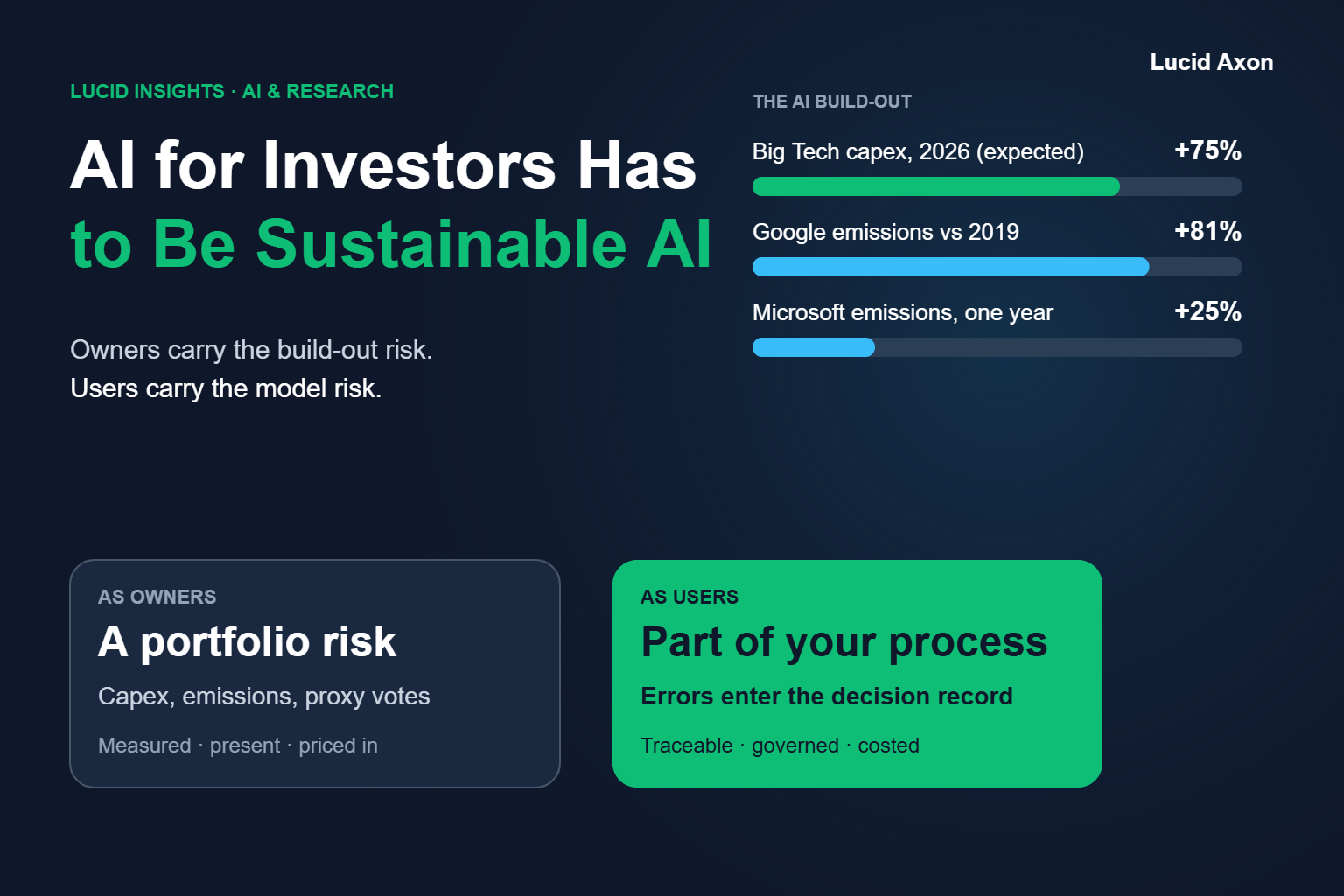
Investors meet AI twice. As owners, they hold the companies building it and carry the risks of that build-out. As users, they are putting AI inside research, screening and reporting. On both sides the same standard applies: the AI has to be measured, traceable and governed.
As owners: AI is now a portfolio risk
The AI build-out is one of the largest capital programmes in the market. The IEA puts capital spending by the five largest technology firms above US$400 billion in 2025, and expects it to rise by about 75% in 2026.[1]
That spending is arriving in emissions. Google’s total emissions are 81% above its 2019 baseline,[2] and Microsoft’s rose 25% in a single year.[3] Both companies hold 2030 climate targets that most investors priced in as credible.
Shareholders are already asking about it. In 2026, As You Sow and other investors filed proposals at Amazon, Meta and Alphabet on how AI’s electricity demand fits their climate commitments. Per Glass Lewis, support reached 18.4% at Amazon, 7.4% at Alphabet and 6.9% at Meta.[4]
- 18.4%Amazon, AI power-demand proposal support, 2026
- 7.4%Alphabet, AI power-demand proposal support, 2026
- 6.9%Meta, AI power-demand proposal support, 2026
Those are minority votes, and the proposals keep returning. An investor who asks Microsoft how its AI squares with its climate plan will be asked the same about the AI in their own process.
As users: the AI in your process is part of your process
An investment decision is only as defensible as the evidence under it. When AI reads the filings, scores the company or drafts the assessment, its errors become part of the decision record.
The errors are measurable. One study reports GPT-4 with retrieval reaching about 77% accuracy when extracting ESG data from Hong Kong-listed companies’ reports.[5] That is useful as a first pass, and it leaves roughly one data point in four needing correction.
There is a second failure that accuracy scores miss. Research at ACL 2025 found that language models tend to repeat exaggerated sustainability claims as if they were performance.[6] A tool can extract a disclosure perfectly and still pass greenwashing straight into a portfolio.
A tool can extract a disclosure perfectly and still pass greenwashing straight into a portfolio.
The fix that researchers converge on is traceability. The ChatReport project tied every answer to its source passage and kept experts in the loop.[7] Regulators are moving the same way: OSFI’s Guideline E-23 takes effect on 1 May 2027 and brings AI models, including vendor models, under model risk management.[8]
The AI you buy sits in your own footprint
AI bought as a service is a purchased good. It belongs in the buyer’s Scope 3 inventory, and firms reporting under ISSB or Canada’s CSSB standards will need a number for it.
That number is harder to get than it should be. Google reports 0.24 Wh for a median Gemini text prompt.[9] Mistral’s lifecycle assessment, which also counts training and hardware, reports 1.14 g CO₂e and 45 mL of water per response.[10] The methods differ, so the figures cannot be compared.
Accounting basis matters as well. A Guardian analysis in September 2024 estimated that location-based emissions from four large technology firms’ own data centres were about 7.6 times their officially reported figures for 2020 to 2022.[11]
The footprint is also a design choice. A 2024 study found task-specific models about 30 times less carbon-intensive than general-purpose ones on question answering.[12] An investor can ask a vendor which kind it uses, and why.
Five questions to ask any AI vendor
Investors already know how to do this. It is the due diligence they run on portfolio companies, pointed at their own tools.
| Question | What a good answer looks like |
|---|---|
| Can I see the source behind every output? | Each claim, score or flag links to the passage, document and date it came from |
| Does the tool separate what a company reports from what is verified? | Reported, verified and inferred data are labelled, and likely greenwashing is flagged |
| What does one assessment cost in energy, carbon and water? | A figure per assessment, location- and market-based, with the method published |
| Which models do you use, and why those? | Small task-specific models where they suffice, larger ones only where needed |
| How is the system governed? | Human review of material outputs, accuracy audits, and alignment with ISO/IEC 42001 or OSFI E-23 |
A vendor that cannot answer these is asking the investor to carry the risk instead.
The same standard, turned inward
Investors ask companies to measure their impact, disclose it and show the evidence. Sustainable AI asks the same of the tools investors use to make those judgments.
We think this is where AI for investors is heading. Better analysis will matter, and so will being able to show where each conclusion came from and what it cost to produce. See how Lucid Axon works for investors.
- [1]IEA, Key Questions on Energy and AI, April 2026
- [2]Google, 2026 Environmental Report, 2026
- [3]DCD, Microsoft reports 25 percent increase in CO2 emissions, 2026
- [4]As You Sow, Investor concerns mount as Big Tech’s AI power race threatens credibility on climate, May 2026
- [5]ESGLens: An LLM-Based RAG Framework for Interactive ESG Report Analysis, 2026
- [6]Towards Robust ESG Analysis Against Greenwashing Risks, ACL 2025
- [7]ChatReport: Democratizing Sustainability Disclosure Analysis through LLM-based Tools, 2023
- [8]OSFI, Guideline E-23: Model Risk Management, effective 1 May 2027
- [9]Google, Measuring the environmental impact of AI inference, 2025
- [10]The Decoder, Mistral AI publishes the first comprehensive life cycle assessment of a large language model, 2025
- [11]The Guardian, analysis of data-centre emissions, 15 September 2024
- [12]Power Hungry Processing, FAccT 2024